XOR example
The xor example is a port of tinymind (C++)’s XOR example: a multilayer perceptron with 2 inputs, 4 tanh hidden neurons and 1 sigmoid output learns the XOR function, trained entirely in fixed-point arithmetic.
How it works
- Training samples are random XOR cases drawn with a re-implementation of glibc’s
rand(), seeded as the C++ example seeds it, so both programs see the same samples in the same order. - Each step runs a forward pass, computes the mean-squared error, and back-propagates with SGD and momentum unless the error is already within tinymind (C++)’s zero tolerance.
- Every 100 steps the program logs the mean absolute error over the four XOR cases. At the end it sweeps the trained network over a 41×41 input grid.
Run it
cargo run --release --example xor -- output                  # Q16.16 (the C++ example's format)
cargo run --release --example xor -- --format q8.8 output    # Q8.8
cargo run --release --example xor -- output 0.25 0.5         # optional learning rate and momentum
It writes three files into the output directory, the same files the C++ example writes, byte for byte:
| File | Contents |
|---|---|
nn_fixed_xor.txt | Every weight, the target, the output and the error after each of the 20,000 steps, in raw fixed-point units |
xor_training.csv | The four-case error every 100 steps |
xor_decision_surface.csv | The trained network’s output over the input grid |
Q16.16
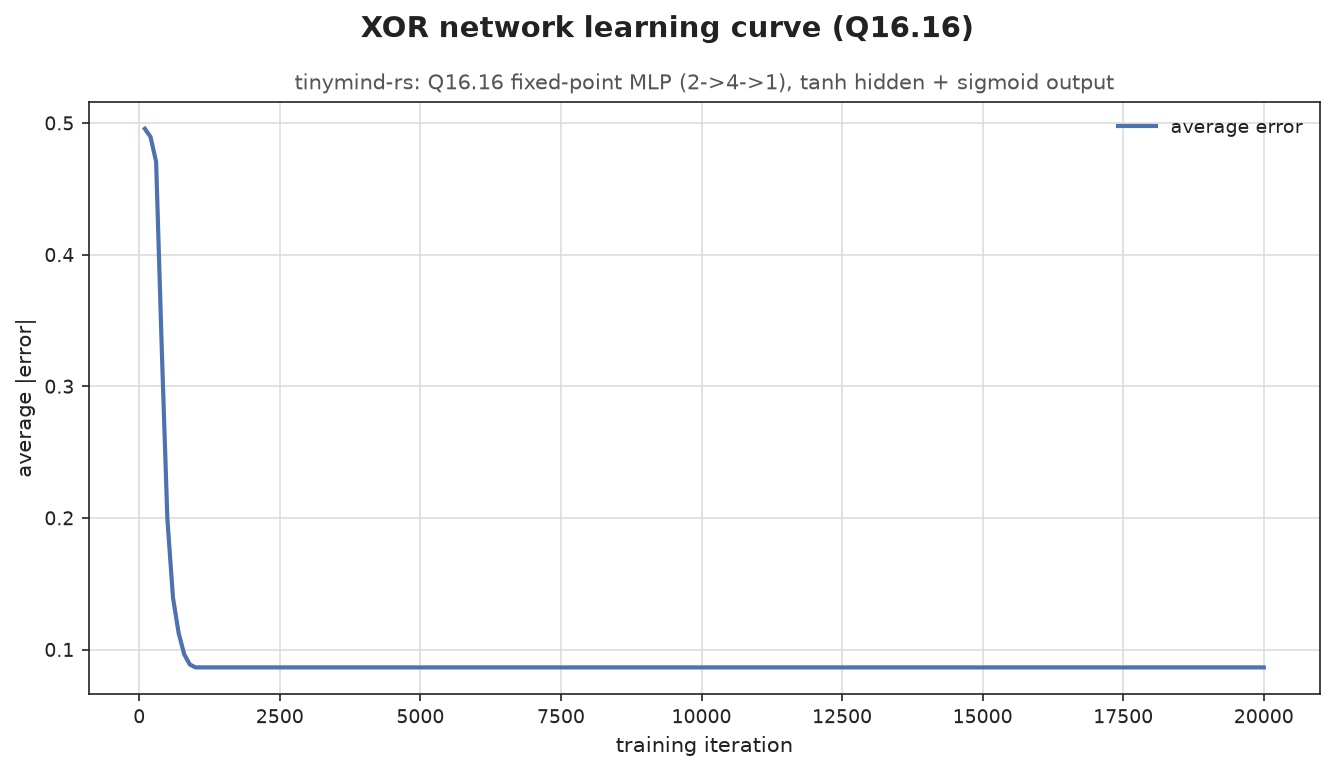
The error falls smoothly from the symmetric-guess level (about 0.5) and settles within about 1,000 steps. All four cases are then classified correctly, with predictions of about 0.08 to 0.09 and 0.91. The remaining error is the sigmoid output not saturating fully to 0 or 1 under the squared-error objective.
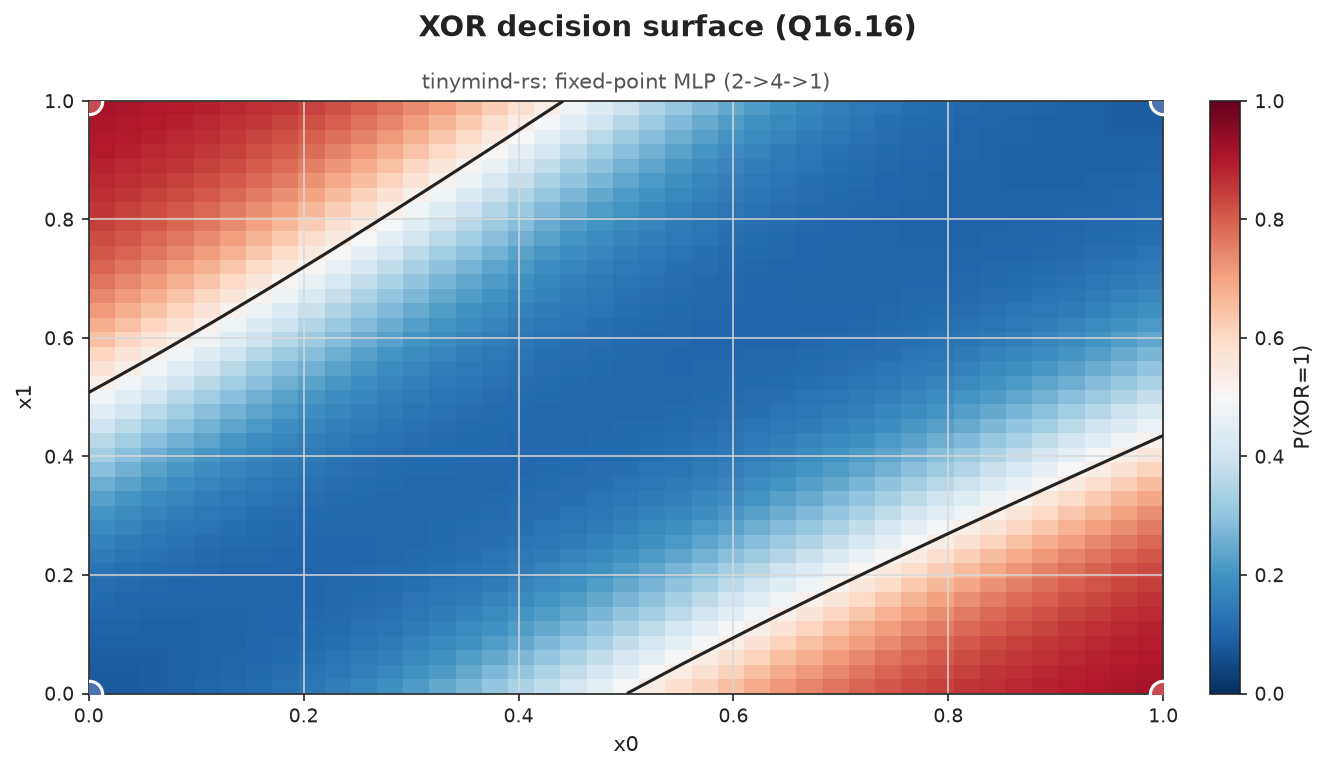
The heatmap is the network’s output over the input square, the black line is the 0.5 decision boundary, and the corner markers are the XOR targets (red = 1, blue = 0).
Q8.8
tinymind (C++) ships this example in Q16.16 only. The Q8.8 run is the same program with 8 integer and 8 fractional bits, compared against the C++ example built the same way.
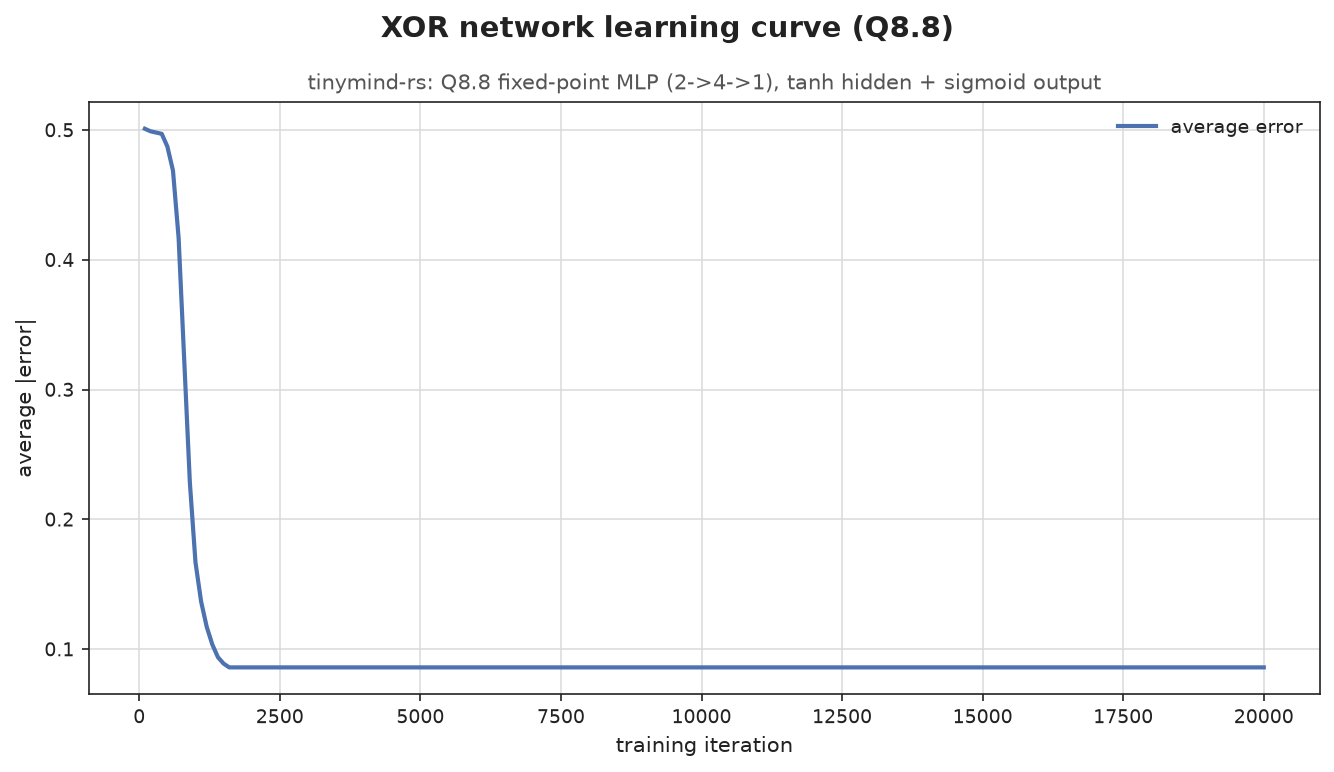
With 1/256 resolution the error stays near 0.5 for about 600 steps, then falls to 0.086 by step 1,600 and stays there. All four cases are classified correctly, with predictions of 0.086 and 0.914 (22 and 234 in raw Q8.8 units).
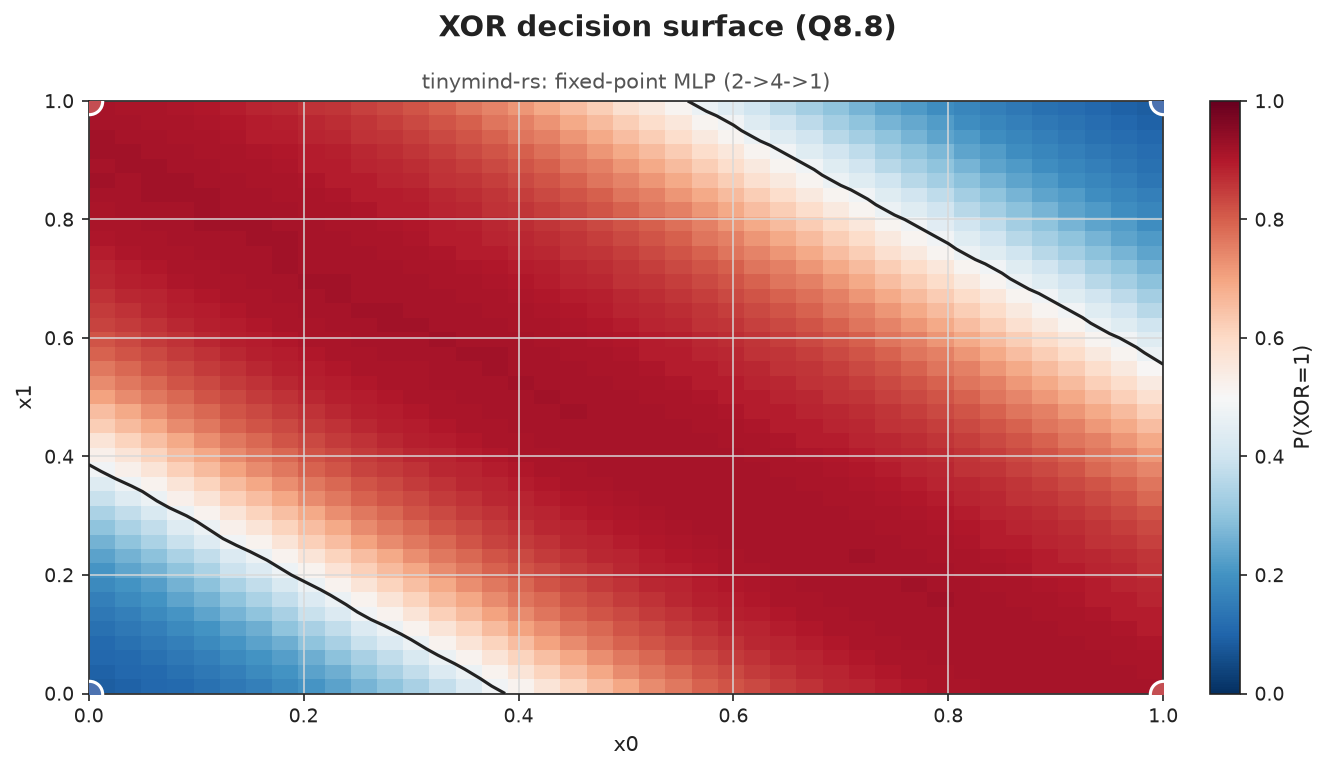
The network separates the two classes with a diagonal band: about 82% of the input square is above 0.5, and only the corners around (0, 0) and (1, 1) fall below it. tinymind (C++)’s notes on this example say that Q8.8 with three hidden neurons lurched through plateaus before snapping to a solution, which is why its example uses Q16.16 with four; they add that with four it learns XOR in Q8.8 too, from 100 of 100 random seeds.
Shipping a trained network
tinymind (C++) can build a network without its training machinery (IsTrainable = false) and load trained weights into it. The port does the same with InferencePerceptron: it holds only the weights, one value per connection, and its outputs are bit-identical to the trainable network’s. Get one from a trained MultilayerPerceptron with to_inference(), or write the weights out as a static, which places them in flash on a microcontroller (InferencePerceptron::new is a const fn). set_weights loads them back into a trainable network, for example to fine-tune on the device.
Network sizes in bytes on a Cortex-M4 (C++ with arm-none-eabi-g++ 13.2; the Rust sizes are the same on a 64-bit host; the panic-check firmware asserts the 2-3-1 and 2-4-1 sizes on Cortex-M):
| Network | tinymind (C++) trainable | tinymind (C++) inference-only | tinymind-rs trainable | tinymind-rs inference-only |
|---|---|---|---|---|
| Q8.8, 2-3-1 | 228 | 88 | 156 | 26 |
| Q8.8, 2-5-1 | 316 | 116 | 228 | 42 |
| Q16.16, 2-4-1 (this example) | 428 | 156 | 384 | 68 |
| Q16.16, 4-8-3 (the iris shape) | 1,364 | 436 | 1,280 | 268 |
The inference-only network keeps no neuron outputs between calls: the hidden activations live on the stack during feed_forward (16 bytes for this example), so a network stored in flash uses no RAM of its own. Sizes are sizeof / size_of, which is what tinymind (C++)’s size tables report. A test checks the inference network against tinymind (C++)’s untrainable one, loaded with the same weights, in both formats and both shapes.
The plots are drawn from this port’s output with tinymind (C++)’s plotting style (scripts/plot-examples.py).