CfC Sequence (Closed-form Continuous-time)
Trains a Closed-form Continuous-time (CfC) cell plus a linear readout to track an irregularly-sampled decaying sinusoid, feeding the varying per-step elapsed time into the cell’s time-gate.
How it works
- A single
CfCCell<1, 8, 16>(one input, eight state neurons, 16-unit backbone) fromcpp/cfc.hppfollowed by an 8-weight + bias linear readout. Inference runs indouble; weights are a flat caller-owned array. Float build (TINYMIND_ENABLE_FLOAT=1,TINYMIND_ENABLE_STD=1). - Demonstrates the solver-free CfC cell: a backbone trunk, two tanh heads, and a time-gated interpolation between them, with no inner ODE iteration per step.
- The headline feature is irregular sampling. Each of the 20 steps advances time by a varying delta
tsthat feeds the CfC time-gate, while the target is a continuous decaying sinusoid sampled at those irregular instants. The same scalar-templatedstep<S>supplies theRevVartraining gradient and thedoubleinference pass; training is 8000 epochs ofpinn::sgdStepReversewith momentum.
Build and run
cd examples/cfc_sequence
make release
make run
make plot      # needs matplotlib; a venv/pyenv works if it is not already in your Python
make run writes cfc_loss.csv (per-epoch training loss) and cfc_fit.csv (per-step ts, target, and predicted), which plot.py reads. The example exits non-zero unless the loss at least halves. Reverse-mode training is gated by the example’s -DTINYMIND_CFC_REVERSE_TRAINING=1.
Output
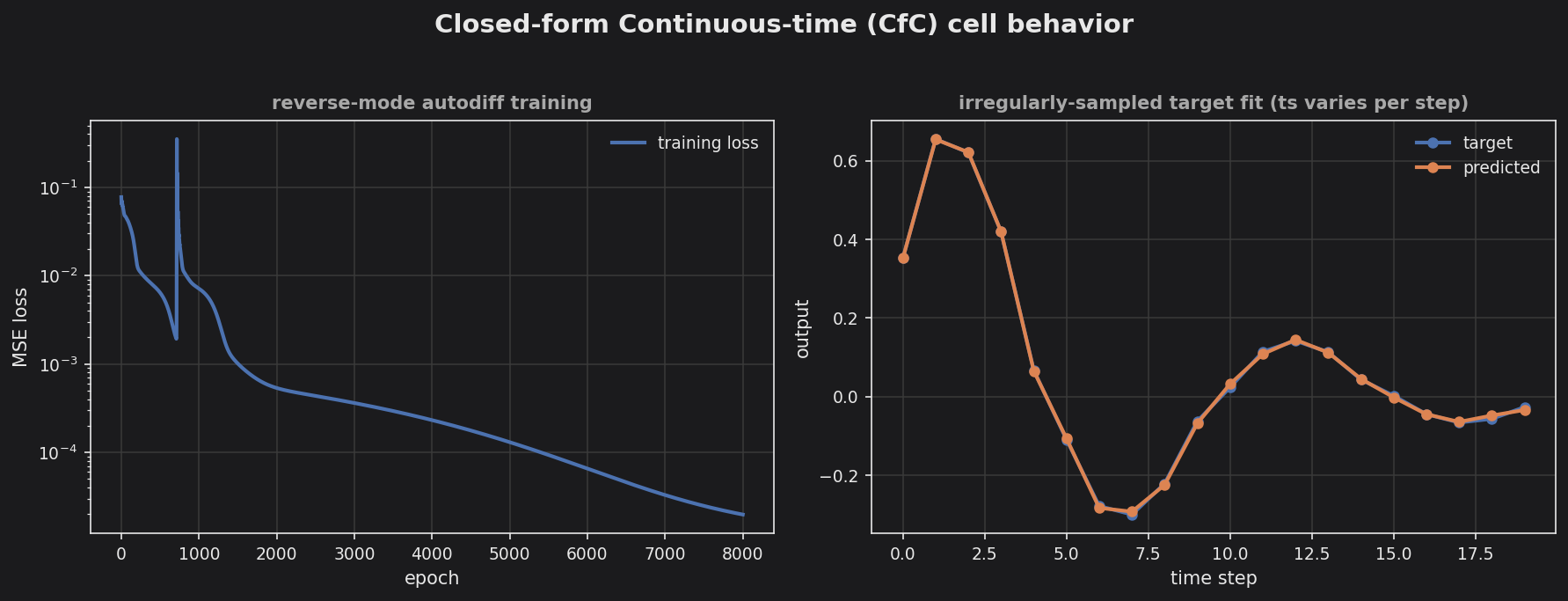
The left panel shows the MSE loss decreasing across training (the early transient spike is the momentum optimizer settling). The right panel overlays the predicted output on the irregularly-sampled decaying-sinusoid target; the curves track closely, showing the CfC cell handles non-uniform time steps that a plain RNN cannot represent.