Energy Efficiency Regression
A two-output building energy-load regressor trained on the UCI Energy Efficiency dataset, predicting the heating and cooling load of a building from its design geometry.
How it works
- Q16.16 fixed-point MLP, 8 → 16 → 2, ReLU hidden layer and 2 linear outputs (Y1 = heating load, Y2 = cooling load).
- tinymind’s smallest end-to-end regression example — the linear-output counterpart to the sigmoid/argmax classifier in Iris. It exercises
LinearActivationPolicyplusGradientClipByValue(clamp to [-1, 1]) with momentum and acceleration disabled, the combination a fixed-point linear head needs to stay stable. - The 8 design features are z-score normalized then scaled by 1/3; the two targets are standardized to z-score (scaled by 1/6) for training and de-standardized back to real load units for reporting. 40k iterations of uniform sampling from the 80% training split.
Build and run
cd examples/energy_efficiency
make release
make run
make plot      # needs matplotlib; a venv/pyenv works if it is not already in your Python
The full 768-row dataset (~35 KB) ships with the example as ENB2012_data.csv; the Makefile copies it into ./output/ before the run, so there is nothing to download.
Output
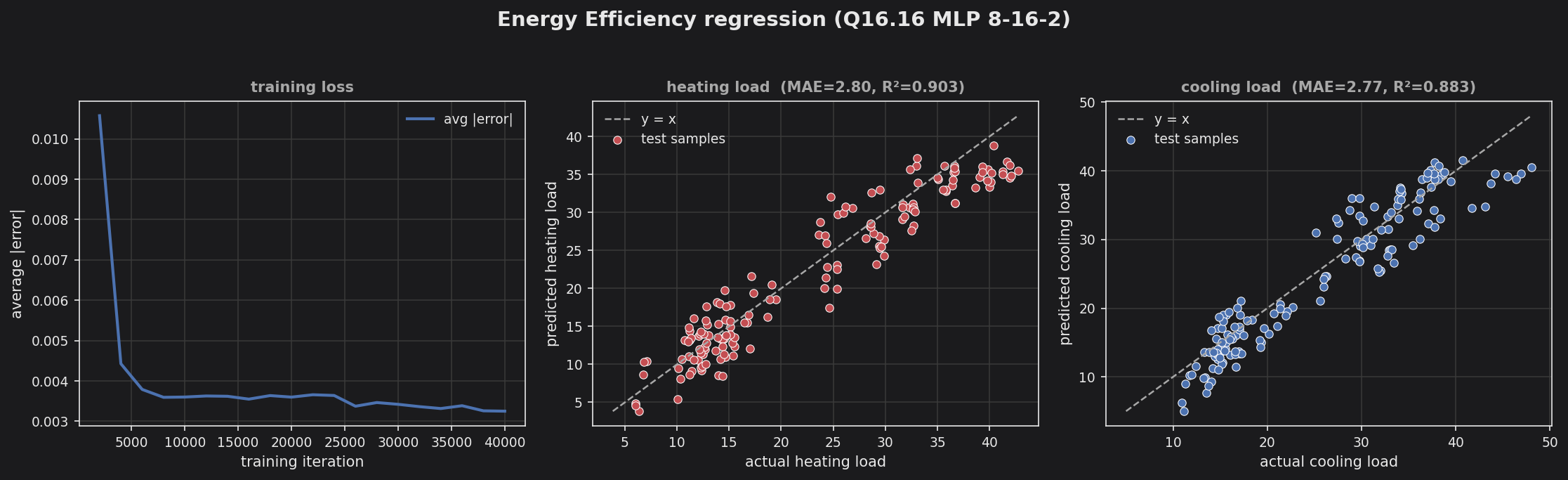
The loss falls quickly in the standardized target domain, and both predicted-vs-actual scatters hug the y=x reference line. On the held-out split the fixed-point MLP reaches heating-load R² ≈ 0.95 (MAE ≈ 1.7) and cooling-load R² ≈ 0.93 (MAE ≈ 1.8). Ordinary least squares on the same features and split reaches R² 0.92 and 0.89 (MAE 2.08 and 2.21), so the nonlinear hidden layer adds real accuracy.
The example trains on every sample. An earlier version skipped samples whose error was within the fixed-point zero tolerance, which at this target scaling meant every residual under about 5 kWh/m²; it reached only R² 0.90 and 0.88, worse than the straight-line fit.