LTC Sequence (Liquid Time-Constant)
Trains a Liquid Time-Constant (LTC) cell plus a linear readout to reproduce the step response of a leaky integrator, using only the existing reverse-mode autodiff trainer.
How it works
- A single
LtcCell<1, 6>(one input, six state neurons, sigmoid synapse) fromcpp/ltc.hppfollowed by a 6-weight + bias linear readout. The scalar type isdoublefor inference; weights live in a flat caller-owned parameter array. Float build (TINYMIND_ENABLE_FLOAT=1,TINYMIND_ENABLE_STD=1). - Demonstrates the continuous-time LTC cell: a fused semi-implicit-Euler ODE step with per-neuron time constants, advanced once per input sample over a 24-step sequence.
- Because
LtcCell::step<S>is scalar-templated, the same forward code differentiates throughRevVar(reverse-mode autodiff) to supply the training gradient and runs as plaindoublefor inference, with no hand-written LTC backprop. Training is 3000 epochs ofpinn::sgdStepReversewith momentum, clamping per-neuron tau positive after each step.
Build and run
cd examples/ltc_sequence
make release
make run
make plot      # needs matplotlib; a venv/pyenv works if it is not already in your Python
make run writes ltc_loss.csv (per-epoch training loss) and ltc_fit.csv (target vs predicted across the sequence), which plot.py reads. The example exits non-zero unless the loss drops at least 10x. Reverse-mode training is gated by the example’s -DTINYMIND_LTC_REVERSE_TRAINING=1.
Output
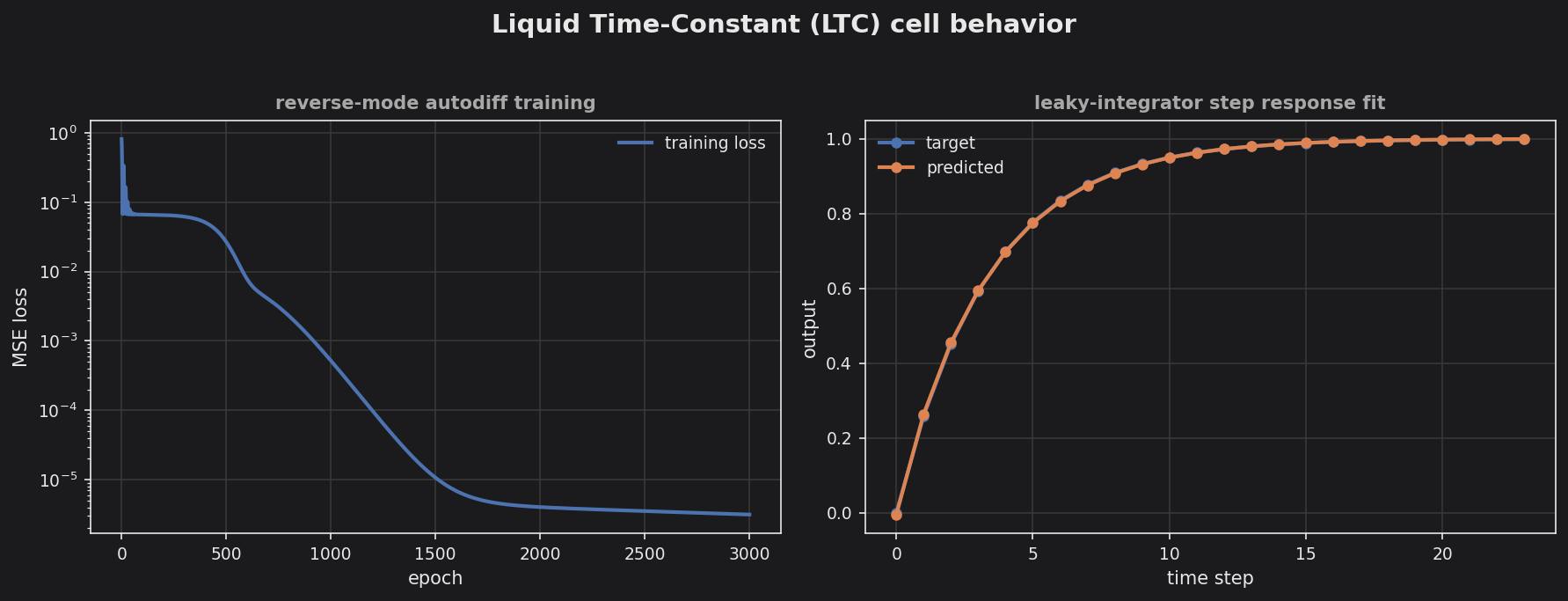
The left panel shows the MSE loss falling several orders of magnitude over training as the reverse-mode gradient tunes the cell and readout. The right panel overlays the predicted output on the leaky-integrator target step response; the two curves are visually indistinguishable, confirming the autodiff-trained LTC cell fits the dynamics.