Human Activity Recognition (LSTM)
A recurrent human-activity classifier over tri-axial accelerometer sequences, inspired by the UCI Human Activity Recognition Using Smartphones dataset. It discriminates WALKING, WALKING_UPSTAIRS, SITTING, and STANDING from raw motion.
How it works
- Q16.16 fixed-point LSTM, 3 inputs → one hidden LSTM layer of 16 tanh neurons → 4 sigmoid outputs, with
GradientClipByValuefor stable recurrent fixed-point training. - Demonstrates TinyMind’s
LstmNeuralNetwork<>— a recurrent net trained and run entirely inQValuefixed-point — applied to sequence classification rather than the feed-forward MLP path. - Each window is 32 timesteps. The LSTM is stateful across
feedForwardcalls, so the cell state is reset (resetState()) at the start of every window; all 32 steps are supervised toward the constant window label so the net settles on its decision as evidence accumulates, and the prediction is read (argmax) at the final timestep. 45 epochs of shuffled passes.
Build and run
cd examples/har_activity
make release
make run
make plot      # needs matplotlib; a venv/pyenv works if it is not already in your Python
By default the example synthesizes physically-motivated tri-axial accelerometer windows (deterministic, seed 7): sinusoids + harmonics + noise for the dynamic activities and near-flat gravity vectors for the static ones, normalized into Q16.16’s stable range (200 windows/class train, 50/class test). To use real data, drop a long-format har.csv (window,t,ax,ay,az,label, contiguous rows per window) into ./output/ and it is loaded instead, with an 80/20 deterministic split.
Output
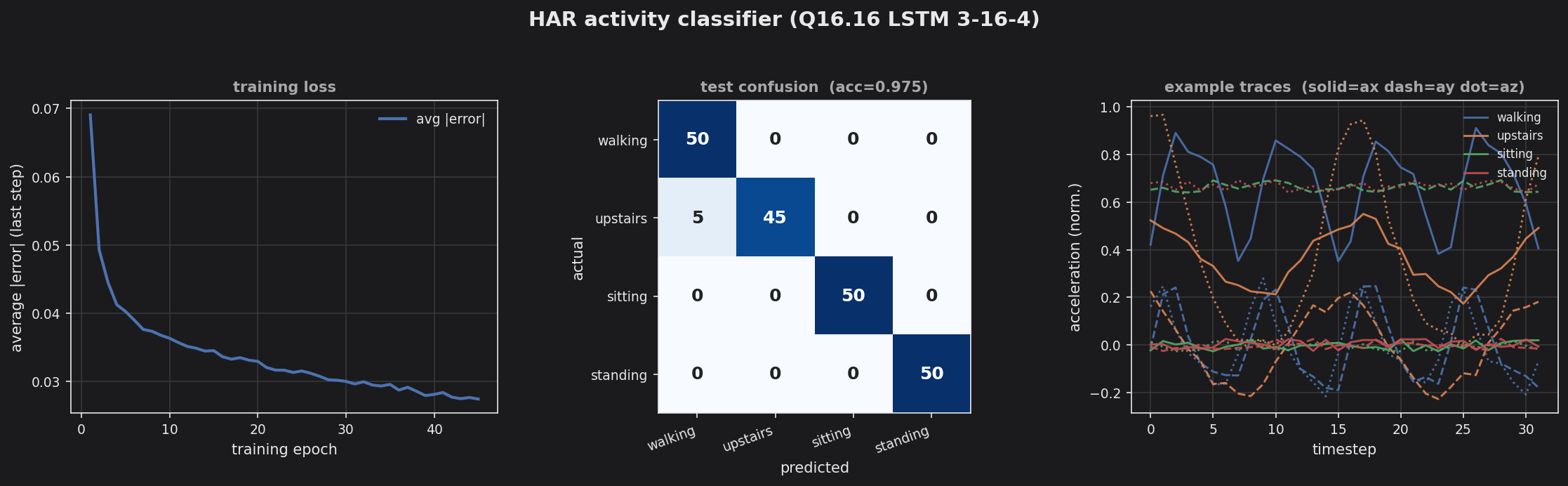
The loss converges to ~0.027 average error and the confusion matrix is almost perfectly diagonal at ~97.5% test accuracy (195/200). The only residual confusion is a few WALKING_UPSTAIRS windows read as WALKING — the genuinely harder frequency-discrimination case — while the static SITTING/STANDING classes are nailed, as the per-activity accelerometer traces make visually clear.