LSTM Sinusoid — Floating-Point vs Q16.16
The floating-point counterpart to LSTM Sinusoid. The same LSTM, the same periodic training stream, and the same seed, topology, and epoch budget are trained twice — once with ValueType = double, once with ValueType = QValue<16, 16> — then overlaid on one chart so the quantization cost can be read off directly. This is the only example that exercises a recurrent (LSTM) network in floating-point; every other RNN exemplar in the repo is fixed-point only.
How it works
- One input (
sin[t]scaled to [0, 1]), a single hidden layer of 16 LSTM units, one sigmoid output — identical on both precision paths. 20 samples/period, 20000 epochs over the continuous streamsin[t] -> sin[t+1]with the recurrent state wrapping across the period boundary. - Both nets are seeded identically (
srand(7)) before construction, and both weight initializers draw from[-0.5, 0.5], so they start from comparable inits — the only difference between the two runs is the numeric type. - The library only ships
FixedPointTransferFunctions. The floating-point transfer-function bundle and thedoubleactivation specializations (TanhActivationPolicy<double>,SigmoidActivationPolicy<double>,Constants<double>,ZeroToleranceCalculator<double>) at the top of the source are the same onesunit_test/nn/nn_unit_test.cppuses to exercise the float path. The LSTM cell internally hardcodes sigmoid gates and tanh cell-state, so those twodoublespecializations are what the recurrent path actually calls. - One-step-ahead is always fed the true
sin[t]— it measures how well the dynamics were learned. Free-run feeds each prediction back as the next input — the honest generation test, where small one-step errors compound into amplitude/phase drift.
Build and run
cd examples/lstm_sinusoid_float
make release
make run       # writes output/lstm_sinusoid_float.csv
make plot      # needs matplotlib; a venv/pyenv works if it is not already in your Python
make run writes output/lstm_sinusoid_float.csv with columns step,true,float_one_step,float_free_run,q_one_step,q_free_run over a two-period horizon (the sinusoid is scaled to the [0, 1] range to match the sigmoid output).
Output
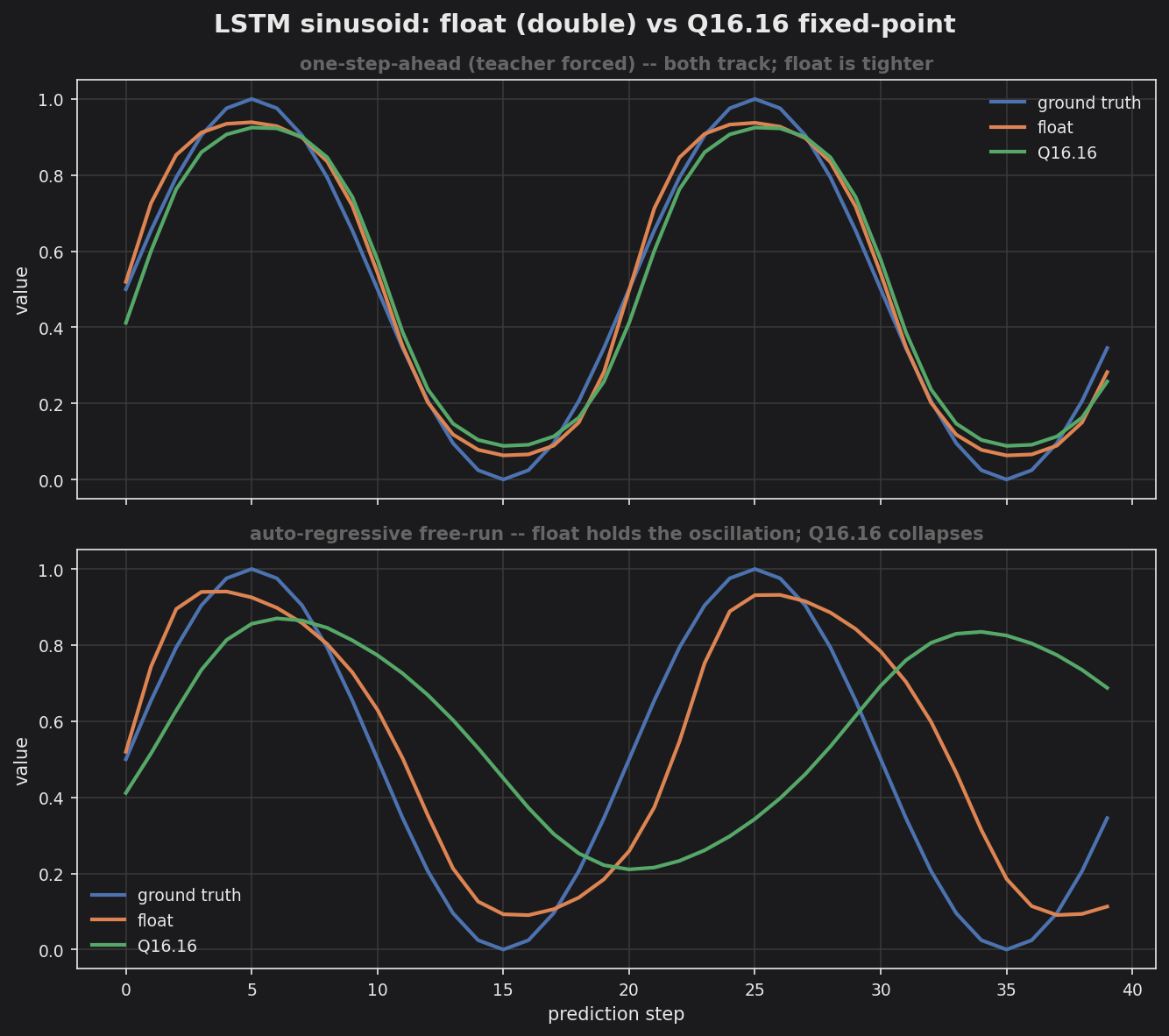
- One-step-ahead (top): both precisions track the sinusoid closely; the float curve sits a hair tighter and the Q16.16 curve lags slightly at the peaks. Neither reaches exactly 0 or 1 — the sigmoid output saturates before the rails, an activation artifact shared by both paths, not a precision effect.
- Free-run (bottom): the float net keeps oscillating with roughly the right amplitude through both periods, accumulating only a slow phase lag, while the Q16.16 net collapses in the second period — the coarser fixed-point grid loses the phase information the LSTM state needs to stay on the sinusoid.