int8 ResNet Residual Block
A single int8 ResNet-style residual block stitched together from the Phase 10 composition ops and per-channel convolution. Demonstrates SAME-padding, a skip connection, and TFLite ADD semantics all on the int8 affine grid.
How it works
- Pipeline:
QPad2D(1,1)→QConv2DPerChannel 3x3→qrelu→QPad2D(1,1)→QConv2DPerChannel 3x3, thenQAddof that branch with the identity skip, then a closingqrelu, over a4x4x2input. QPad2Dpads with each tensor’s input zero_point so padded cells decode back to real-zero in the affine domain; it carries SAME padding around the VALID convolutions to preserve spatial dimensions.QAddrescales the conv branch and the identity skip onto a shared output grid viabuildQAddParams(TFLite ADD’s left_shift + three multiplier/shift triples).- Calibration is host-side: the block runs in float over an 8-sample synthetic dataset to collect activation ranges, then
computeAffineParamsAsymmetricfits per-tensor activation params andcomputePerChannelSymmetricScalesfits per-channel weight scales. Block end-to-end error is ~15% of output range — a four-stage int8 chain without QAT or cross-layer equalization picks up double-digit relative error; the pass threshold is 25%.
Build and run
cd examples/resnet_block_int8
make release
make run
make plot      # needs matplotlib; a venv/pyenv works if it is not already in your Python
Built with -DTINYMIND_ENABLE_QUANTIZATION=1 (plus FLOAT=1 STD=1 for the host-side calibration). make run prints the per-tensor affine params and the worst max-abs error versus the float reference; make plot renders the parity overlay from output/resnet_block_int8.csv.
Output
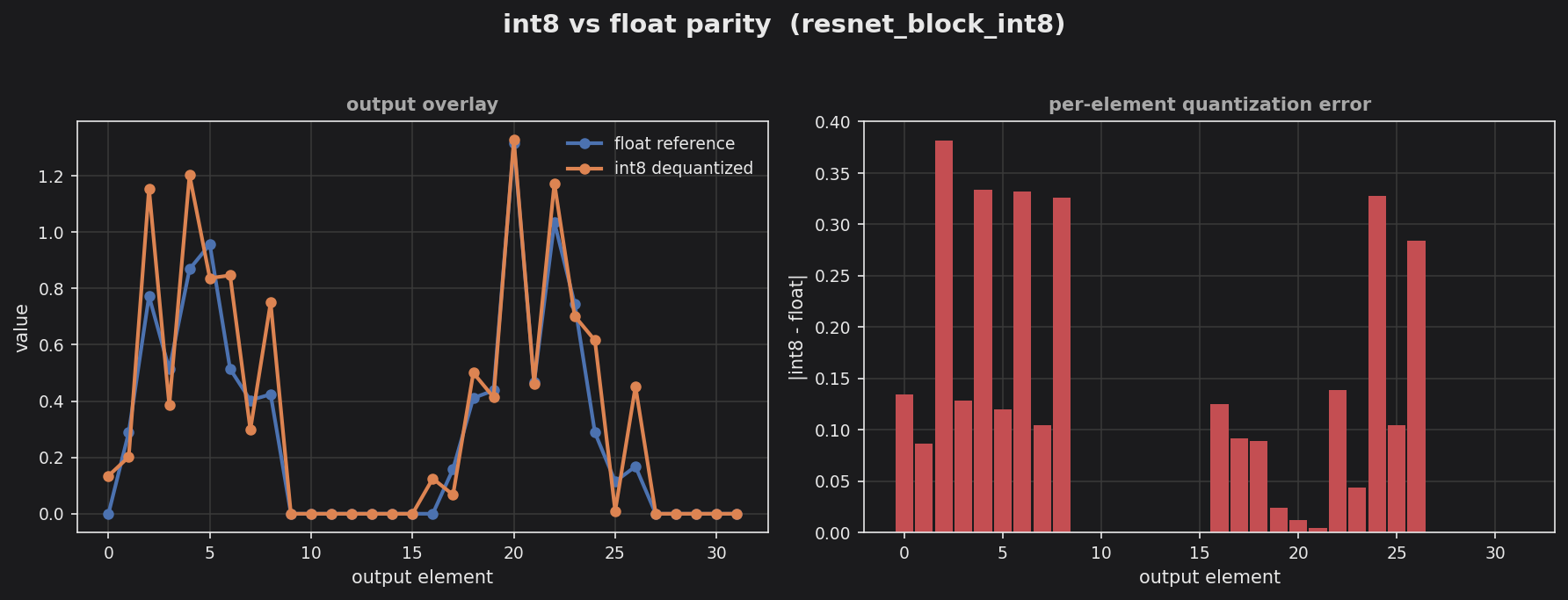
Left panel overlays the float reference against the int8-dequantized output across all 32 output elements; the two tracks follow each other but visibly diverge at the peaks. Right panel plots the per-element absolute error, which tops out around 0.38 — consistent with the documented ~15% of output range for this un-equalized four-stage int8 chain.