int8 QCfC Liquid Cell
A pure-integer int8 deployment of a Closed-form Continuous-time (CfC) liquid cell, calibrated on the host and run through a recurrent forward pass with no <cmath> on the inference path.
How it works
- A small
QCfCCell(3 inputs, 6 hidden units, 8-unit backbone) fromcpp/qcfc.hpp: int8 weights and activations, int32 accumulators, integer requantization, and sigmoid/tanh lookup tables. It is the deployable counterpart of the floatcfc.hppcell. - Demonstrates the int8 quantization path (
TINYMIND_ENABLE_QUANTIZATION=1) applied to a recurrent liquid cell: the cell is driven over a 24-step input sequence — three phase-shifted sinusoids — and its hidden trajectory is compared step by step against a float reference. The structured drive gives the state a real two-sided dynamic range, so the parity plot reads as a quantization staircase riding the float curve rather than dithering in a tiny structureless band. - This is the regular-sampling deployable form: the elapsed time
tsis a calibration constant folded into the time-gate-A requantizer and the combined time bias. Host-side calibration usesqcalibration.hpp; the runtime forward pass is integer-only.
Build and run
cd examples/qcfc_liquid_int8
make release
make run
make plot      # needs matplotlib; a venv/pyenv works if it is not already in your Python
make run reports the max-abs int8-vs-float hidden-state error (PASS if under 10% of the hidden range; ~0.0045, about 1.9% of the range, on the bundled seed) and writes qcfc_parity.csv for plot.py. Two extra modes: make bench emits a CSV cycle/byte report, and make golden emits a deterministic int8 hidden-state byte stream suitable for an integration-suite fixture. The build is hosted for the parity report; the deployable shape is QUANT=1 FLOAT=0 STD=0.
Output
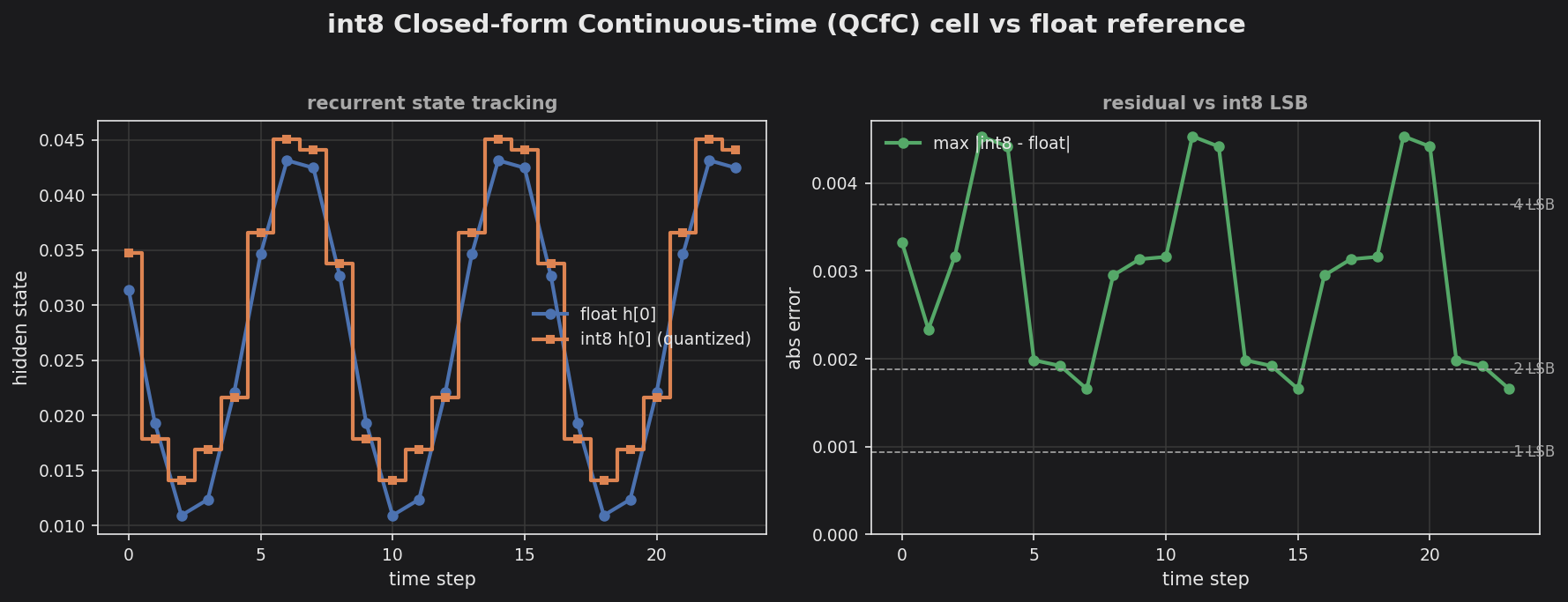
The left panel overlays the int8 hidden state on the float reference across the 24 steps; the int8 trace rides the smooth period-8 float curve as a quantization staircase. The right panel plots the per-step max-abs error against horizontal 1/2/4-LSB guide lines — the residual sits between two and four int8 LSBs throughout, showing the gap is purely grid-resolution (int8 quantization, LUT, and requantizer rounding combined), not a modelling or convergence failure. This separation is the point: the int8 cell preserves the recurrent dynamics; what you see is the cost of the int8 grid, nothing more.