LSTM Sinusoid
Trains an LSTM to predict the next value in a sinusoidal sequence, then evaluates it two ways: one-step-ahead (always fed the true value) and auto-regressively (fed its own predictions back). A genuine sequence-modeling task rather than a static classifier.
How it works
- Q16.16 signed fixed-point LSTM network (
tinymind::LstmNeuralNetwork) with one input, a single hidden layer of 16 LSTM units, and one output; tanh + sigmoid activations and a mean-squared-error loss with gradient clipping. - A single scalar
sin[t]is an ambiguous predictor ofsin[t+1]— the rising and falling branches of the sine share y-values — so the network must use its recurrent state to track phase. Q16.16 gives that state enough precision; the coarser Q8.8 grid collapses the free-run onto the 0/1 rails. - Trained on a continuous periodic stream (20 samples/period, the state wrapping across period boundaries). At evaluation the state is reset and primed with one true period (warm-up) so it locks onto the phase before predicting.
- One-step-ahead is always fed the true
sin[t]— it measures how well the dynamics were learned. Free-run feeds each prediction back as the next input — the honest generation test, where small one-step errors compound into amplitude/phase drift.
Build and run
cd examples/lstm_sinusoid
make release
make run
make plot      # needs matplotlib; a venv/pyenv works if it is not already in your Python
make run writes output/lstm_sinusoid.csv with columns step,true,one_step,free_run over a two-period horizon (the sinusoid is scaled to the [0, 1] range to match the sigmoid output).
Output
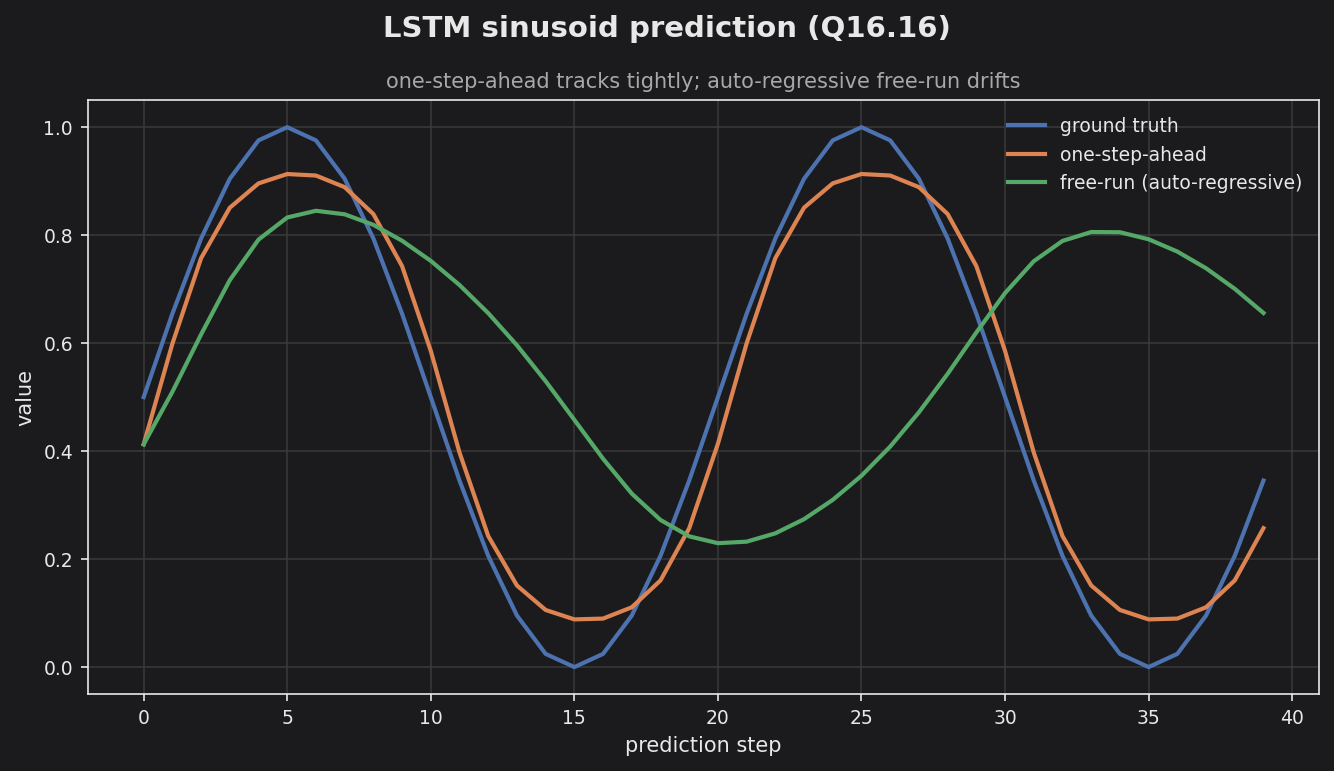
The orange one-step-ahead prediction tracks the blue ground-truth sinusoid tightly across both periods (correct phase, peaks mildly damped by the sigmoid range). The green auto-regressive free-run holds the right period for the first cycle, then drifts in phase and amplitude as closed-loop errors compound — the expected difficulty of long-horizon generation from a single scalar input.