Iris Species Classifier
A three-way iris species classifier trained on the classic UCI Iris dataset (sepal/petal measurements for setosa, versicolor, and virginica).
How it works
- Q16.16 fixed-point MLP, 4 → 8 → 3, ReLU hidden layer and 3 sigmoid outputs (one-hot, predicted class is the argmax).
- The smallest end-to-end “train + deploy on an MCU” classification path in TinyMind — a
NeuralNet<>feed-forward MLP trained and run entirely inQValuefixed-point. - The 4 input features are z-score normalized using training-set statistics, then scaled by 1/3 to sit inside Q16.16’s stable range; 30k iterations of uniform random sampling from the 80% training split.
Build and run
cd examples/iris
make release
make run
make plot      # needs matplotlib; a venv/pyenv works if it is not already in your Python
The full 150-row dataset (~4 KB) ships with the example as iris.data; the Makefile copies it into ./output/ before the run, so there is nothing to download.
Output
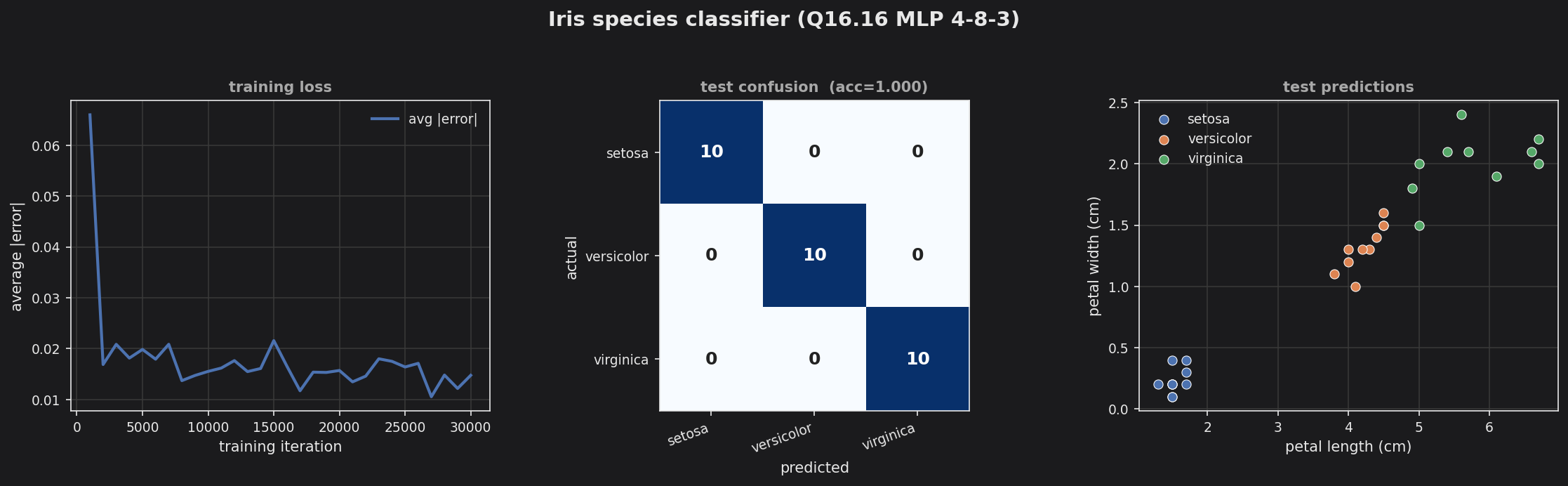
The loss converges cleanly to ~0.015 average error and the confusion matrix is perfectly diagonal — 100% test accuracy (30/30). The petal length-vs-width scatter shows why: the three species form well-separated clusters that the fixed-point MLP nails on the held-out split.