Mackey-Glass ANFIS
Jang’s original 1993 benchmark for ANFIS: predict x(t+6) of the Mackey-Glass chaotic time series from four delayed samples — x(t-18), x(t-12), x(t-6), x(t). Two generalized-bell membership functions per input over the full grid is 2^4 = 16 rules with first-order consequents: 448 bytes of model in Q16.16. Built on cpp/anfis.hpp and apps/anfis_train.
How it works
- Training is host-side, inference is not. Jang’s hybrid scheme solves the consequents by least squares (they enter the output linearly given fixed premises) and only then descends on the premises.
apps/anfis_train/anfis_train.pyruns that loop in numpy and emits the frozen premise, rule-table, and consequent arrays asanfis_model.hpp;cpp/anfis.hppnever trains. - Two value types, one frozen model. The example runs the same parameters in
doubleand in Q16.16, so the fixed-point cost is measured rather than assumed. The C++doubleresult reproduces the Python trainer’s number exactly, which cross-checks the two forward passes against each other. - The rules are readable. Per-rule mean normalized firing strength over the held-out set says what fraction of the output each rule owned — the reason to reach for ANFIS over a dense net of the same size.
- Arithmetic only. Generalized bells with the exponent pinned at 1 need no transcendental function and no lookup table, so the shipped model would deploy unchanged at
FLOAT=0/STD=0. The example enablesFLOATandSTDonly for itsdoublereference and<cmath>error metrics.
Results
| value | |
|---|---|
| rules | 16 |
| premise / consequent parameters | 16 / 80 |
| Q16.16 model size | 448 bytes |
| held-out samples | 500 |
| test RMSE (double) | 0.004066 |
| test RMSE (Q16.16) | 0.004081 |
| max abs Q16.16 vs double | 0.001677 |
Test RMSE is 0.43% of the target range; the fixed-point path costs 0.4% more error than the double reference.
Build and run
cd examples/anfis_mackey_glass
make release
make run                 # writes output/*.csv
make plot                # needs matplotlib; a venv/pyenv works
make regenerate-model    # optional: refit with train.py (needs numpy)
make golden              # deterministic Q16.16 stream for the integration gate
The model is committed, so the build needs no Python.
make golden emits the byte stream that unit_test/integration locks byte-for-byte, the same gate the int8 exemplars carry. It contains only raw Q16.16 integers and rule indices — never formatted doubles, since the fixed-point path is reproducible across compilers and optimization levels while printed floating point is not (verified identical under -O0, -g, -O3, and -O2 -ffast-math). The rule indices ride along because the defuzzified output alone could mask a regression in the premise or t-norm stages.
Output
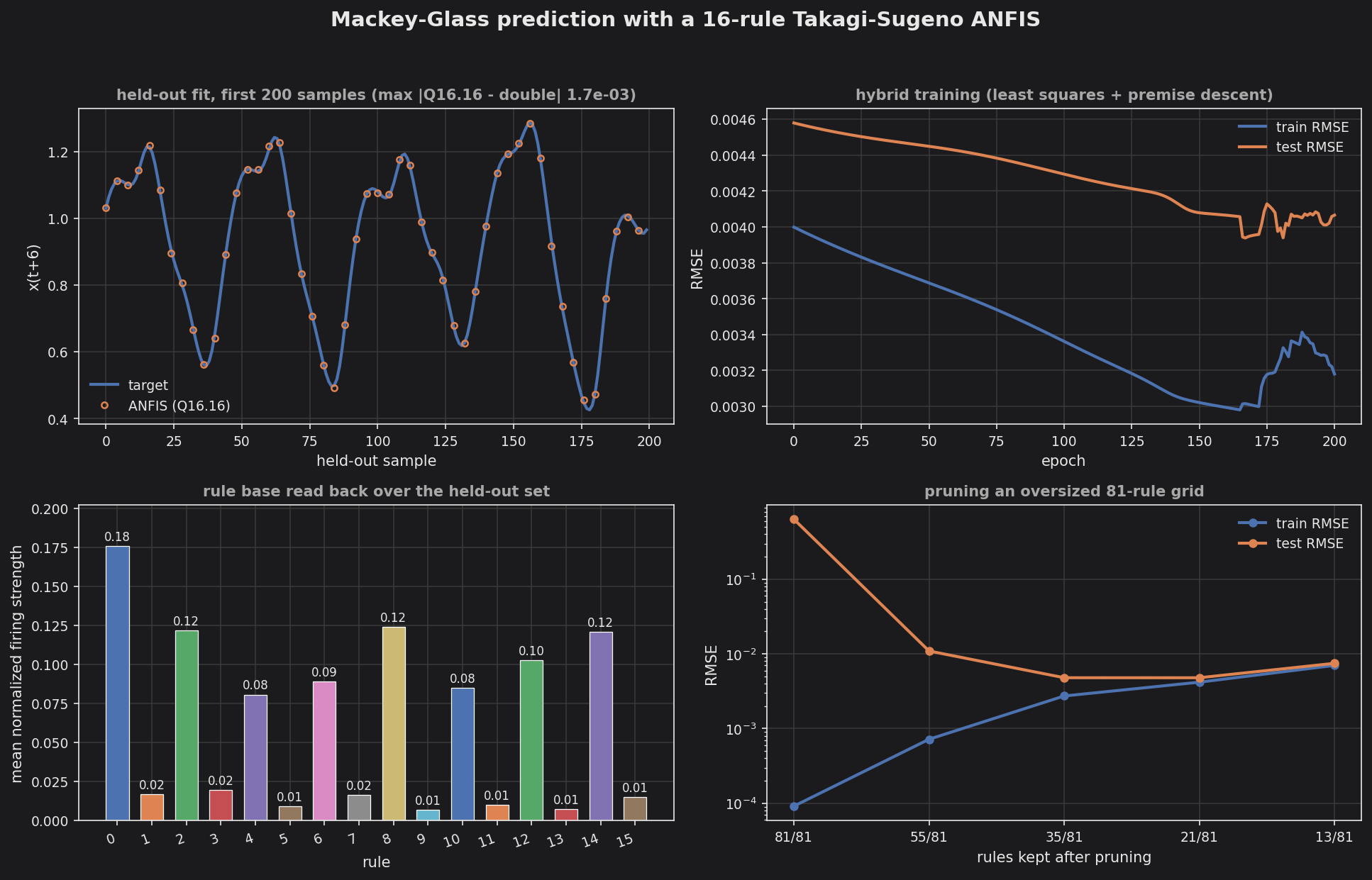
Held-out fit. The prediction tracks every swing of the chaotic series; the Q16.16 output is drawn as sparse markers because a third line would hide under the other two.
Hybrid training. Epoch 0 is the least-squares-only baseline (test RMSE 0.004579); tuning the premises alongside it reaches 0.004066. The late wobble is the fixed-size normalized premise step bouncing near the optimum.
Rule base read back. Rule 0 carries 18% of the output; the eight odd-numbered rules together carry under 10%. An odd rule index means “the second membership function of x(t)”, so the model barely uses the upper half of its most recent input.
Pruning an oversized grid. Three membership functions per input is 81 rules and 405 consequent parameters against 500 training samples — it overfits catastrophically (train RMSE 0.000091, test RMSE 0.636). Pruning by mean firing strength recovers it: 21 of 81 rules gives test RMSE 0.004793, a ~130x improvement while shipping 26% of the rule base. This is why cpp/anfis.hpp carries an explicit rule table rather than an implicit M^N grid. Read the figures qualitatively: the unpruned 81-rule design matrix is rank deficient (rank 402 of 405, condition number 9.0e12), so its exact test RMSE shifts with floating-point summation order, while the shipped 16-rule model is full rank (condition number 1.9e5) and reproducible exactly.