int8 ANFIS (Mackey-Glass)
The same model as Mackey-Glass ANFIS, run through cpp/qanfis.hpp — and a deliberate negative result.
int8 is 9.9x LARGER than Q16.16 for this model. That is the point of the exemplar. Everywhere else in tinymind, moving to int8 shrinks a model; here it does not, and measuring that is more useful than letting the assumption ride.
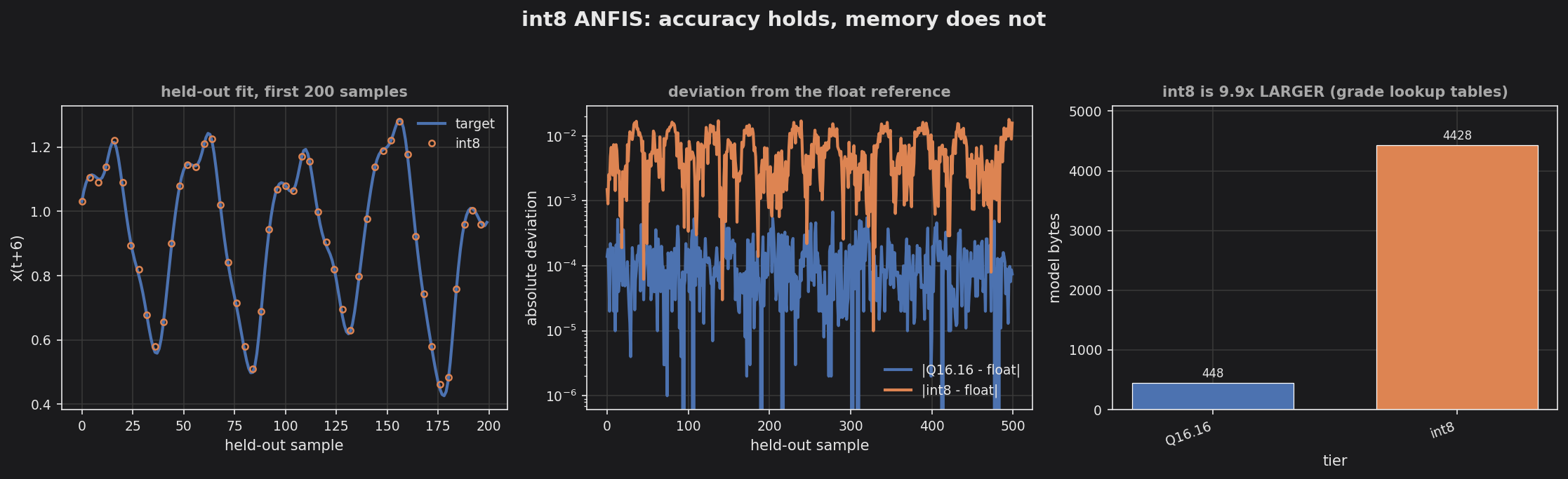
Results
| tier | test RMSE | model bytes |
|---|---|---|
| float reference | 0.003997 | — |
| Q16.16 | 0.003994 | 448 |
| int8 | 0.008566 | 4428 (9.9x) |
| int8, no ridge | 0.025336 | — |
Accuracy holds — int8 costs about 2.1x the float reference’s error on a target spanning 0.94. Memory does not.
Every int8 range (inputs, outputs, and the shared consequent grid) is calibrated from the 500 training samples only; the 500 held-out samples are used for scoring and nothing else.
Why int8 is bigger
An int8 layer’s parameters are usually its weights, and halving their width halves the model. ANFIS spends most of its parameters on membership functions instead, and cpp/qanfis.hpp evaluates those through a 256-entry lookup table per (input, membership function) pair — which is exactly what makes the membership shape irrelevant at runtime.
Those tables cost 512 bytes each regardless of how few parameters the shape they replaced had. A Q16.16 generalized bell is two numbers, eight bytes; its int8 lookup table is 512. Here the tables are 4096 bytes, 92.5% of the int8 model.
Per rule int8 is genuinely cheaper (20 bytes against 24), so the crossover is the fixed table cost divided by the per-rule saving: int8 overtakes Q16.16 at about 1024 rules. This model has 16, and published fuzzy hardware overwhelmingly ships under 25 — so in practice the Q-format tier is the smaller one.
When the int8 tier is worth it
Not for footprint — for pipeline consistency. An int8 frontend (a quantized conv stack, an int8 feature extractor) can feed ANFIS directly with no qbridge conversion and no float on the hot path. If the rest of the graph is already int8, paying 4 KB to keep it integer end to end may be the right call. If ANFIS is the whole model, use Q16.16.
The ridge lesson, measured
| consequent solve | largest coefficient | int8 test RMSE |
|---|---|---|
| ridge = 1e-6 | 9.58 | 0.008566 |
| ordinary least squares | 168.98 | 0.025336 |
Unregularized least squares produces large coefficients that nearly cancel. In float that is harmless — both fits score about 0.004. In int8 it is not: the input carries half a quantization step of error, and a coefficient of 169 amplifies it past the output quantum, breaking the cancellation the fit depends on. This is why apps/anfis_train carries a ridge parameter.
Build and run
cd examples/anfis_mackey_glass_int8
make release
make run                 # writes output/*.csv
make golden              # deterministic stream for the integration gate
make plot                # needs matplotlib
make regenerate-model    # optional: refit with train.py (needs numpy)
make run fails if int8 error exceeds 4x the float reference, so the comparison is a gate rather than a printout. The golden stream carries the footprint numbers alongside the outputs, since the memory comparison is the headline.