int8 seq2seq (softmax decoder)
The softmax-attention counterpart of int8 Encoder-Decoder (seq2seq). Same encoder-decoder shape and calibration flow, but the decoder runs standard softmax attention instead of the linear ReLU-kernel — so it exercises QCausalAttentionSoftmax1D and QCrossAttentionSoftmax1D end-to-end.
How it works
- Same pipeline as the linear variant (
Vocab=16, SEnc=6, SDec=6, E=8, F=16): a linear-attention encoder block produces the memory; the decoder block isQLayerNorm1D→QCausalAttentionSoftmax1D(causal self) →QAdd;QLayerNorm1D→QCrossAttentionSoftmax1D(to memory) →QAdd;QLayerNorm1D→QDense→qrelu→QDense→QAdd. - Growing KV cache. Softmax cannot collapse the attended history into a fixed state the way linear attention does, so
QCausalAttentionSoftmax1Dkeeps aQSoftmaxKVCachethat appends one(K, V)row per emitted token. The causal mask is the cache length — the score loop runs only over the rows that exist. Cross-attention prefills the encoder K/V once and scores every decoder query against all of them. - Softmax in int8 follows the TFLite convention: per-row max subtract, 256-entry exp LUT (
buildQSoftmaxExpLUT), 1/256 probability grid. The score requantizer folds the1/sqrt(d_k)factor viaqAttentionInvSqrt(). The exp LUT is the extra footprint over the linear stack. - Incremental decode == full-sequence, byte-for-byte: the int8 causal self-attention is run as one full-sequence
forward()and asstep()looped token-by-token over the growing cache, and the two int8 streams are asserted identical. - End-to-end error is ~0.9% of output range (pass threshold 50%, looser than the linear variant because softmax compounds more int8 stages).
Build and run
cd examples/seq2seq_softmax_int8
make release
make run
make plot      # needs matplotlib; a venv/pyenv works if it is not already in your Python
Built with -DTINYMIND_ENABLE_QUANTIZATION=1 (plus FLOAT=1 STD=1 for host calibration). make golden writes the int8 byte stream to output/seq2seq_softmax_int8.golden.
Output
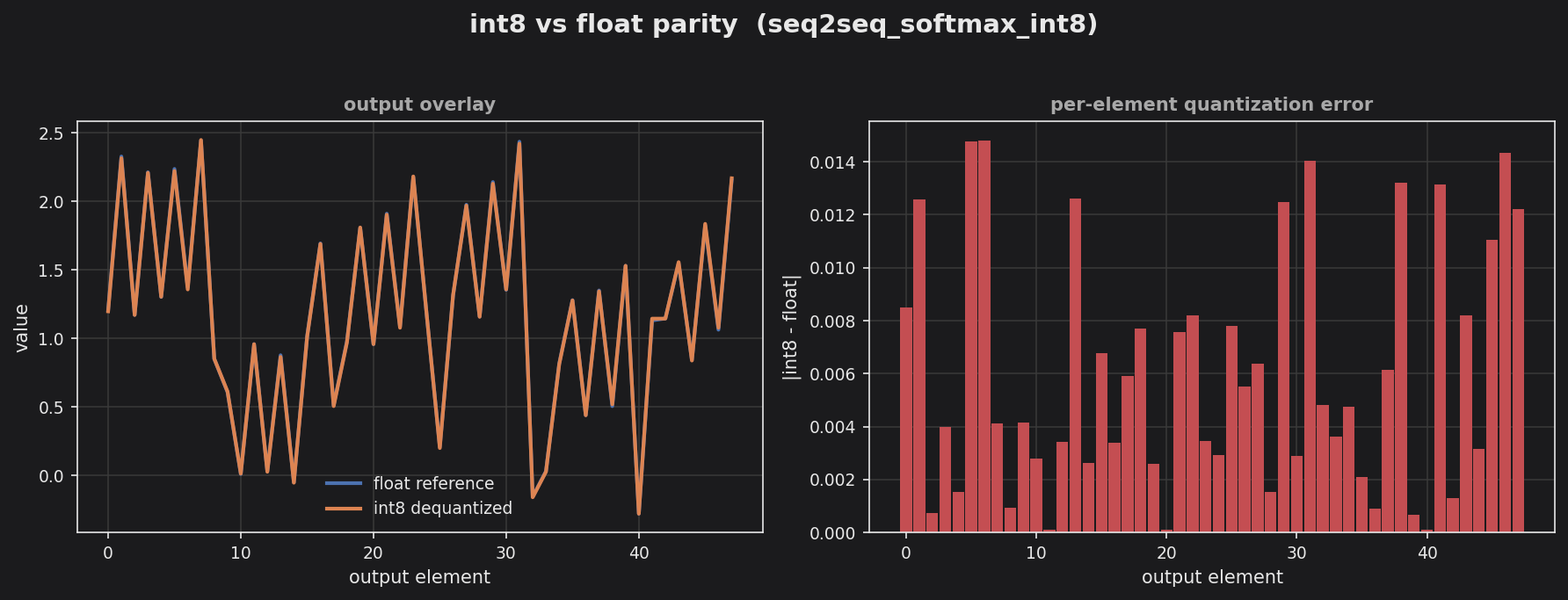
Left panel overlays the float reference against the int8-dequantized decoder output across all 48 elements — nearly indistinguishable. Right panel shows the per-element absolute error, all under ~0.015, consistent with the ~0.9% of output range for this softmax-decoder int8 pipeline.