int8 Encoder-Decoder (seq2seq)
The encoder examples produced a memory tensor; this one adds the decoder that consumes it, completing an int8 encoder-decoder (seq2seq) transformer. The decoder introduces causal self-attention, cross-attention to the encoder memory, and an autoregressive KV cache — all pure integer.
How it works
- Pipeline (
Vocab=16, SEnc=6, SDec=6, E=8, F=16): a source stream runs through one linear-attention encoder block (QLayerNorm1D→QAttention1D→QAdd;QLayerNorm1D→QDense→qrelu→QDense→QAdd) to produce a[SEnc, E]memory. A target stream runs through one decoder block:QLayerNorm1D→QCausalAttention1D(causal self) →QAdd;QLayerNorm1D→QCrossAttention1D(to memory) →QAdd;QLayerNorm1D→QDense→qrelu→QDense→QAdd. QCausalAttention1D(cpp/qcausalattention1d.hpp) is causal linear self-attention: positiontattends only tos <= t. With a linear (ReLU-kernel) feature map the causal mask collapses into a fixedE × Erunning KV matrix (QLinearKVState,cpp/qkvcache.hpp), so autoregressive decode is O(1) memory per token — there is no growing cache.QCrossAttention1D(cpp/qcrossattention.hpp) reads two different affine grids — Q from the decoder hidden state, K/V from the encoder memory — so it carries a separateq_input_zero_pointandkv_input_zero_point, with the matching input scales baked into the per-projection requantizers. The encoder K/V collapse into a singleE × Ematrix at prefill; each decoder query is oneQ' · KV.- The headline check: the int8 causal self-attention is run two ways and asserted byte-identical — one full-sequence
forward()(training-time teacher forcing) versusstep()looped token-by-token over the running KV state (inference-time autoregressive decode). The report printsKV-cache incremental decode == full-sequence: YES (byte-identical). That equivalence is what lets a model trained on full sequences deploy as a streaming decoder on an MCU. - End-to-end error is ~0.7% of output range (pass threshold 40%) for the full encoder + decoder, with no QAT and no cross-layer equalization.
Linear (ReLU-kernel) attention everywhere keeps the whole pipeline freestanding-portable — no softmax/exp LUT. Softmax variants (QCausalAttentionSoftmax1D, QCrossAttentionSoftmax1D) drop in with an exp LUT from buildQSoftmaxExpLUT; both flavors are covered by the quantization unit tests.
Build and run
cd examples/seq2seq_int8
make release
make run
make plot      # needs matplotlib; a venv/pyenv works if it is not already in your Python
Built with -DTINYMIND_ENABLE_QUANTIZATION=1 (plus FLOAT=1 STD=1 for host calibration). Extra target:
make golden— int8 byte stream for the bundled test set tooutput/seq2seq_int8.golden
Output
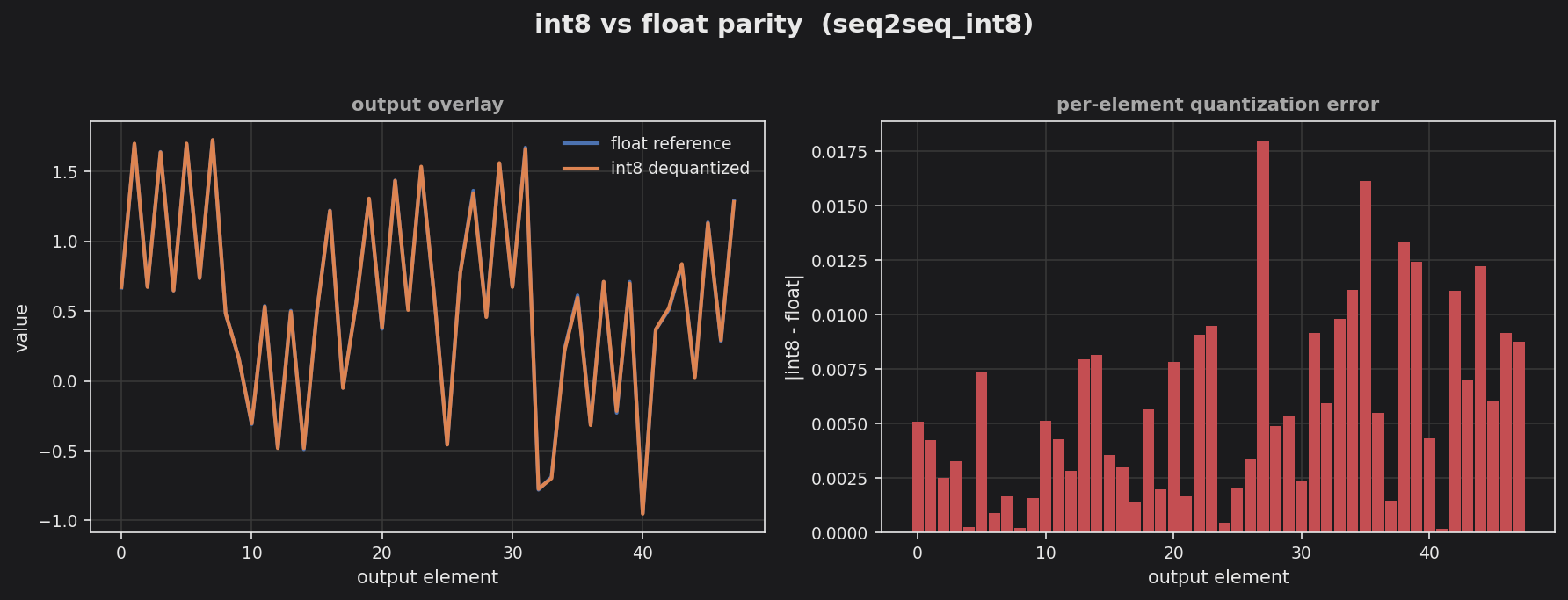
Left panel overlays the float reference against the int8-dequantized decoder output across all 48 elements — the two tracks are nearly indistinguishable. Right panel shows the per-element absolute error, all under ~0.018, consistent with the ~0.7% of output range for this encoder + decoder int8 pipeline.