int8 GBDT (tabular)
An int8 gradient-boosted decision tree (GBDT) ensemble on a 2-feature, 3-class tabular problem — the cheapest model family on a microcontroller. Each prediction is a handful of integer compares and a branch: no MACs, no matmul, no activation tables. Built on cpp/qtree.hpp (QDecisionTree, QGBDT).
How it works
- The ensemble is a small additive set of shallow trees (as a trainer like XGBoost / LightGBM would export). Each tree contributes its int32 leaf value to its target class’s logit; argmax over the per-class logits is the prediction. A single tree / single output (
NumClasses = 1) is the degenerate regression case. - Thresholds quantize losslessly in the comparison. A split compares the feature against an int8 threshold on the same affine grid; because an affine map is monotone,
x_q <= t_qmatchesx_real <= t_real, so the int8 tree reproduces the float tree’s decisions exactly — the only place they can differ is a sample within one int8 grid step (~0.008) of a threshold. - MCU-perfect. The runtime path is pure integer (compare + branch), freestanding-safe — no float, no LUT, no MAC. Nodes are a flat
{feature, threshold, left, right, leaf_value}array and trees share one pool, the layout a trained ensemble exports to. - The driver sweeps a dense 2D grid in float (real thresholds) and int8 (quantized thresholds) and reports ~98% agreement — the remaining couple percent are grid cells sitting on a split boundary.
Build and run
cd examples/gbdt_tabular_int8
make release
make run
make plot      # needs matplotlib; a venv/pyenv works if it is not already in your Python
Built with -DTINYMIND_ENABLE_QUANTIZATION=1 (plus FLOAT=1 STD=1 for host calibration). make golden writes the probe predictions to output/gbdt_tabular_int8.golden.
Output
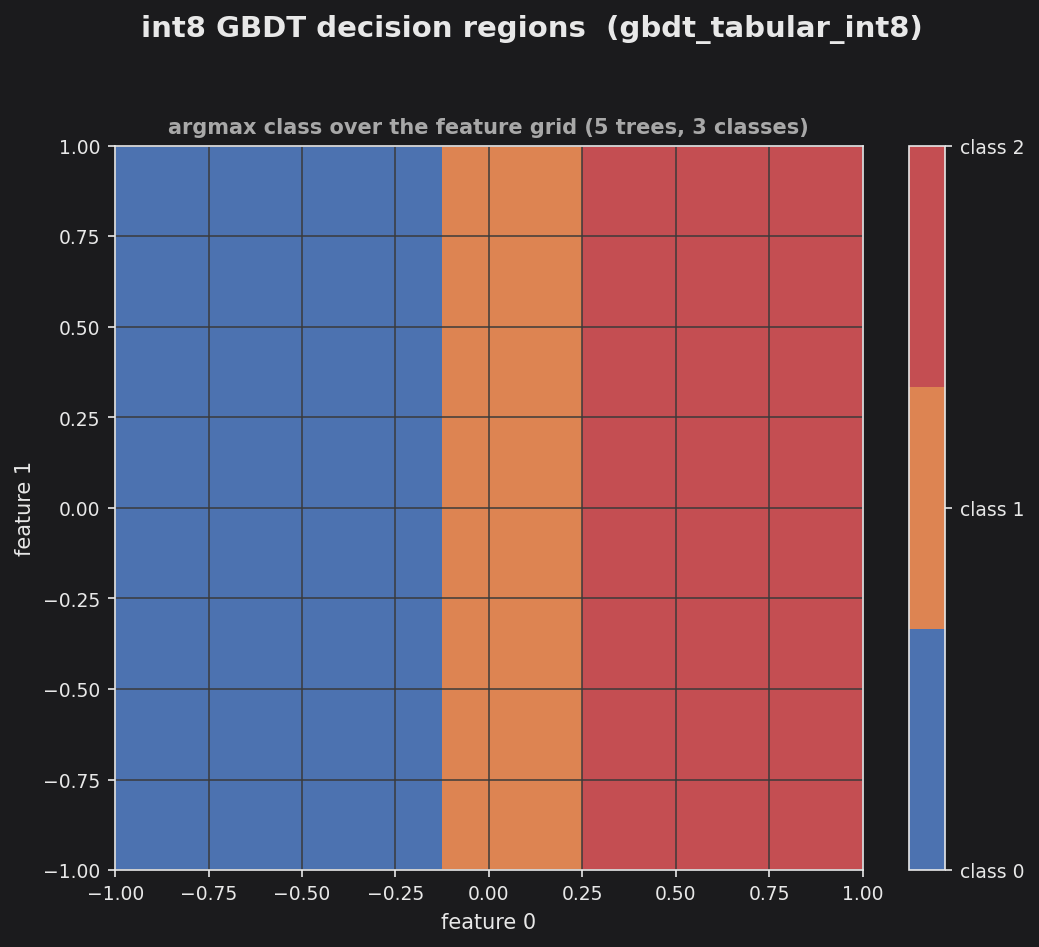
The 2D map colors each feature-grid cell by the int8 GBDT’s argmax class — three vertical bands (class 0 / 1 / 2) split on feature 0. The two f1 trees still add their votes to the class 0 and class 2 logits, but in this hand-built ensemble those votes never outweigh the feature-0 margin, so the boundaries do not move with feature 1; they are there to exercise a second feature in the shared node pool. Summing shallow trees into per-class logits is exactly what gradient boosting builds; a trained ensemble’s trees interact more, and its regions bend accordingly.