LSTM Importer Round-Trip
An end-to-end check that the apps/import_pytorch importer turns a model that starts with an nn.LSTM into something the C++ cpp/qlstm.hpp::QLSTMCell runtime reproduces.
How it works
demo.pylays out a deterministic float LSTM (3 inputs, 8 hidden units) exactly asnn.LSTM’s state dict, gates i, f, g, o, and adds a linear 8 → 2 head, with numpy only. It goes throughLSTM.from_state_dict, the path a trained model takes.-
It calibrates the model twice through
import_pytorch_modelon 128 noisy multi-sine sequences of 24 steps, once with an int16 cell state and once with an int8 one, and emitsweights_cell16.hppandweights_cell8.hpp: the activation scales (the hidden state’s symmetric, zero point 0), the cell scale and range, the fixed 8/127 gate grid, per-gate int8 input and recurrent weights with their scales, the int32 gate biases, and the head’s weights and biases.It also emits
lstm_reference.hpp: 16 held-out sequences, the float model’s outputs, and the float hidden state after every step of the first sequence. The reference comes from the LSTM equations written out separately indemo.py, not from the importer’s own float forward, so the check cannot pass by the importer agreeing with itself. import_lstm_demo.cppfillsQLSTMScalesfrom each header, callsbuildQLSTMParams, builds the sigmoid and tanh LUTs, runsQLSTMCellover each sequence from zero state and theQDensehead on the last hidden state, and compares the dequantized output with the float reference.
Build and run
cd examples/import_lstm_demo
make
make run                  # runs the parity check
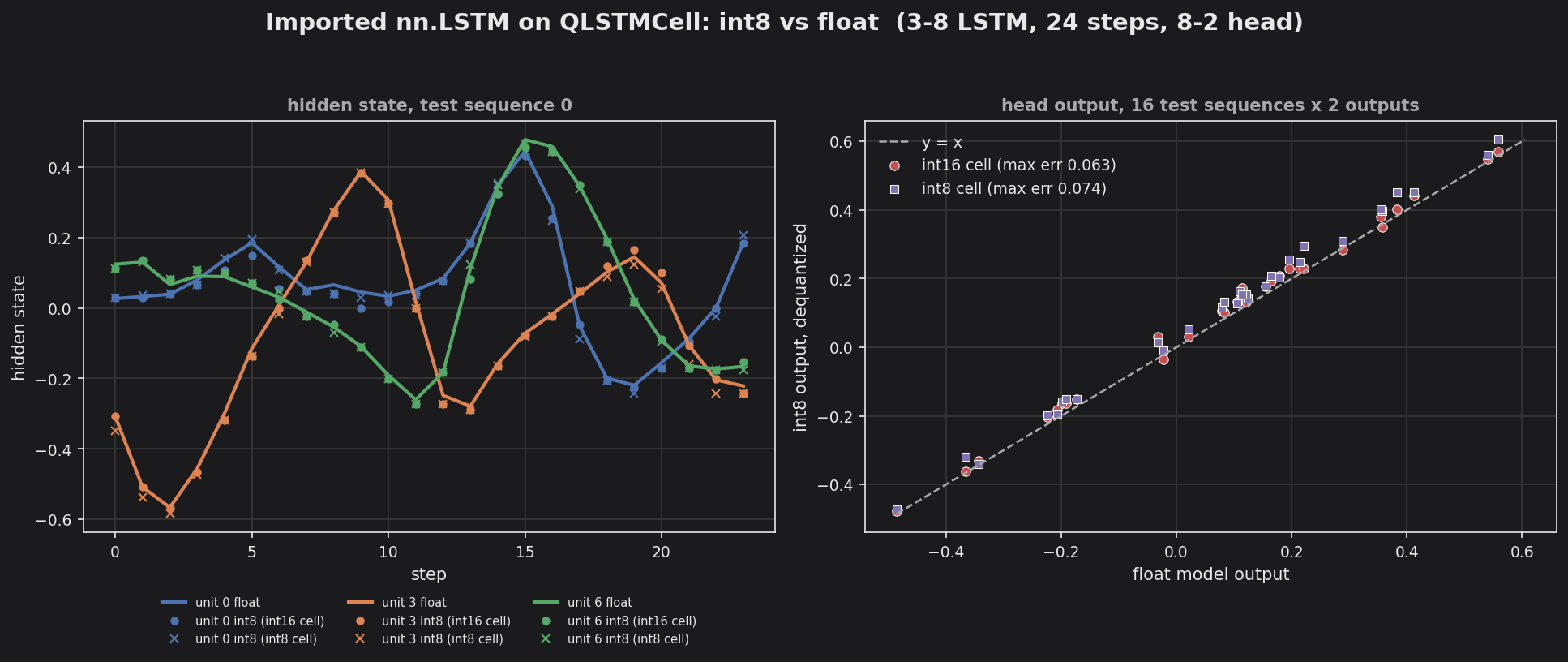
make plot                 # output/import_lstm_demo.png (needs matplotlib)
make regenerate-pytorch   # re-runs demo.py to regenerate the headers (needs numpy)
Output
import_lstm_demo parity test (16 sequences x 24 steps, 3-8 LSTM + 8-2 head)
  int16 cell: max |y_int8 - y_float| = 0.062568  (hidden trace 0.063370)  tolerance 0.080000 : PASS
  int8  cell: max |y_int8 - y_float| = 0.073909  (hidden trace 0.072047)  tolerance 0.080000 : PASS
The mean output error is 0.022 with the int16 cell and 0.035 with the int8 cell. The error is already 0.018 after the first step and does not grow over the 24 steps: it is the floor set by the fixed 8/127 gate grid and the 1/128 tanh LUT, not drift. On this 24-step sequence the int16 cell buys little; cpp/qlstm.hpp recommends it for long unroll horizons, where the int8 cell’s 256 levels are the limit.
See LSTM and GRU for the cell and PyTorch → tinymind int8 (importer) for the importer flow.