Fixed-point Log-mel Front End
cpp/qmel.hpp computes log-mel spectrograms and MFCCs from int16 frames with integer arithmetic only. It is the front end that turns audio or vibration into features a small int8 network can classify. This example runs it over a synthetic 12-second vibration recording and compares every frame with the float definition.
How it works
- The recording, sampled at 3,200 Hz, is a 29.5 Hz motor with harmonics and noise. From 6 seconds on, a bearing fault rings a 900 Hz resonance at 107 impacts per second. The level rises from -50 dBFS to -6 dBFS across the run.
QLogMelSpectrogram<256, 32>windows each 256-sample frame (hop 128) with a Q1.15 Hann window. Pre-emphasis and windowing are exact in 64 bits. The frame is then shifted so its largest sample lies in [2^14, 2^15), which means a quiet frame reaches the int16QRFFT1Dat full scale.- 32 triangular HTK mel filters from 5 to 1,600 Hz are summed in 64 bits, and a fixed-point natural log follows. The frame’s shift and the fixed scalings come back out as an exact integer offset of the base-2 log.
- The output is int16 in Q8 (steps of 1/256 nat).
QMfcc<32, 13>applies an orthonormal DCT-II. - The float definition is torchaudio’s
MelSpectrogram(power 2, HTK mel scale) followed by a natural log.
Build and run
cd examples/logmel_vibration
make release
make run
make plot      # needs matplotlib in a venv
Output
|log-mel error| in nats, by band level below the frame's loudest band:
   0-10 dB:   944 bands  mean 0.0012  p99 0.0036  max 0.0055
  10-20 dB:  1159 bands  mean 0.0017  p99 0.0057  max 0.0083
  20-30 dB:  1550 bands  mean 0.0052  p99 0.0215  max 0.0320
  30-40 dB:  5133 bands  mean 0.0160  p99 0.0669  max 0.1131
    40+ dB:   782 bands  mean 0.0326  p99 0.1423  max 0.2885
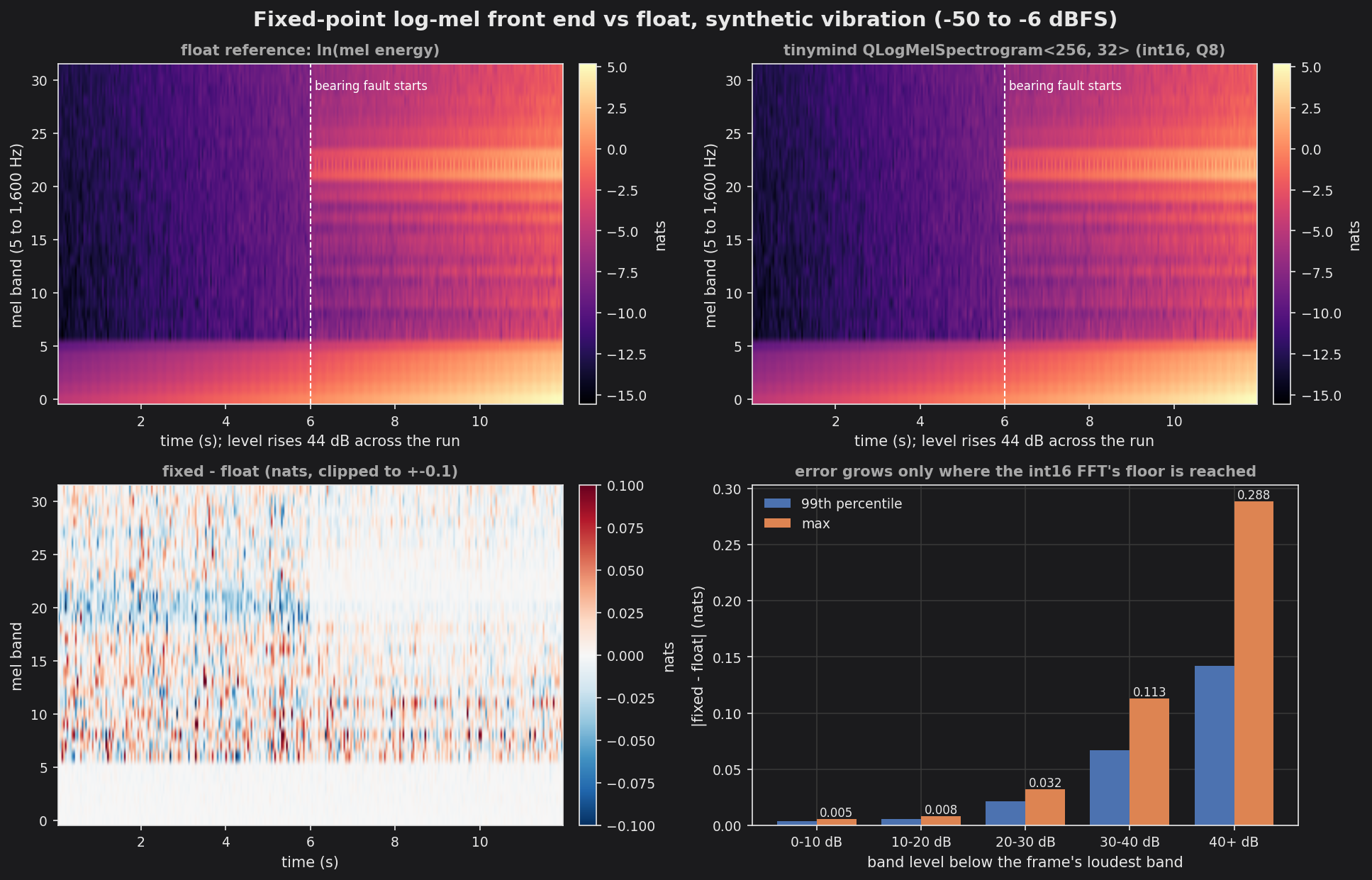
The top row shows the float and fixed-point spectrograms; the fault’s 900 Hz resonance lights up bands 20 to 23 at 6 seconds. The bottom left shows their signed difference. It is no larger at the start of the run, at -50 dBFS, than at the end, at -6 dBFS: the block scale makes the error independent of the input level. The bottom right shows the error by how far a band sits below its frame’s loudest band. Within 20 dB the two agree to 0.01 nats (0.04 dB). Further down, the error grows toward the rounding floor of the 16-bit FFT.
For a Cortex-M0+ at -Os, with N = 256 and 32 bands:
- the code is 1,710 bytes, including
QRFFT1D; - the deepest stack is about 264 bytes;
- the workspace is 1,028 bytes;
- the host-built tables are 1,644 bytes of flash, plus 832 for a 13-coefficient DCT.
Measured on the boards at -O3 (benchmarks/tier1_onboard), a log-mel frame takes 185,172 cycles on the Cortex-M0+ of a NUCLEO-L031K6 (5.8 ms at 32 MHz) and 46,878 on the Cortex-M4 of a NUCLEO-F411RE (0.47 ms); the 13 MFCCs add 33,567 and 4,112.