Human Activity Recognition (LSTM)
A recurrent human-activity classifier over tri-axial accelerometer sequences, inspired by the UCI Human Activity Recognition Using Smartphones dataset. It discriminates WALKING, WALKING_UPSTAIRS, WALKING_DOWNSTAIRS, and SITTING, and the synthetic task is built so that the stairs classes can only be told apart by the order of the samples.
How it works
- Q16.16 fixed-point LSTM, 3 inputs → one hidden LSTM layer of 16 tanh neurons → 4 sigmoid outputs, with
GradientClipByValue, learning rate 0.1 and no momentum (the library default of 0.25 with momentum 0.5 oscillates on this task in Q16.16). - Each window is 32 timesteps. The cell state is reset (
resetState()) at the start of every window; all 32 steps are supervised toward the window label, trained on every step, and the prediction is read at the final timestep as the argmax of the output logits (getPredictedClass()). 60 epochs of shuffled passes. - The three walking classes share the step rate, lateral sway, gravity direction, and the per-axis mean and standard deviation. Level walking has a sinusoidal vertical acceleration; the stairs classes have a sawtooth, and WALKING_DOWNSTAIRS is WALKING_UPSTAIRS played backwards in time, so every individual sample has the same distribution in both. An LSTM that reads one timestep at a time can only separate them by remembering earlier samples.
Build and run
cd examples/har_activity
make release
make run
make plot      # needs matplotlib; a venv/pyenv works if it is not already in your Python
./output/har_activity --readout-only   # ablation: train only the hidden-to-output weights
By default the example synthesizes the accelerometer windows (deterministic, seed 7; 200 windows/class train, 50/class test, generated independently). To use real data, drop a long-format har.csv (window,t,ax,ay,az,label, contiguous rows per window) into ./output/ and it is loaded instead, with an 80/20 deterministic split.
Results
| Model | Test accuracy |
|---|---|
| LSTM, all weights trained | 76.5% (153/200); 89.6% mean over 10 seeds |
LSTM, --readout-only (input, gate and recurrent weights frozen at their random initial values) | 50.0% |
| Nearest centroid on per-axis mean + standard deviation (ignores sample order) | 52.5% |
| Chance | 25% |
The two order-blind baselines both separate SITTING and lose most of the walking classes. Training the LSTM’s gates and recurrent weights is what reads the sample order: it lifts accuracy from 50% to 76.5% on the default seed. Recurrent training in Q16.16 is noisy on this task, though: over data seeds 1 to 10 (weights from seed 1) the full model scores 89.6% ± 10.4% (73.5% to 100%), never at chance, while --readout-only stays at 50% on every seed. The learning rate was 0.05 until SGD steps were rounded to nearest; at 0.05 the unbiased steps leave 8 of those 10 seeds stuck at 50%, and 0.1 gives the numbers above.
Output
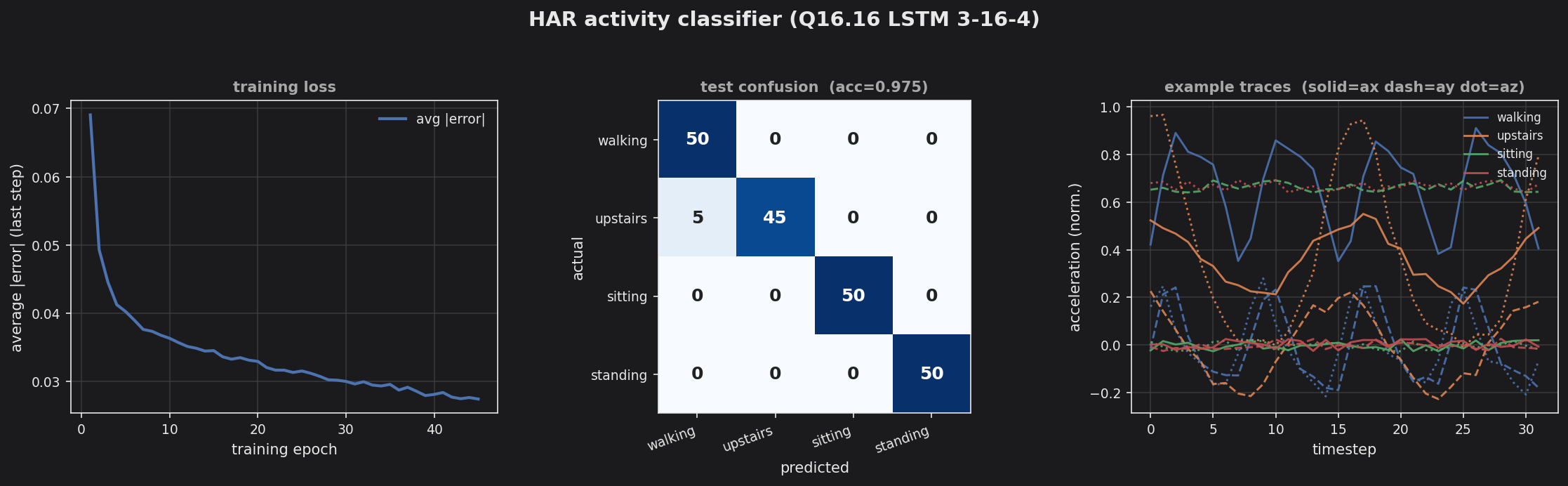
The right panel shows one window of each class. The stairs traces are mirror images in time on the vertical (dotted) axis; the confusion matrix shows SITTING and the stairs classes separated, with most of the remaining errors between level walking and the stairs.